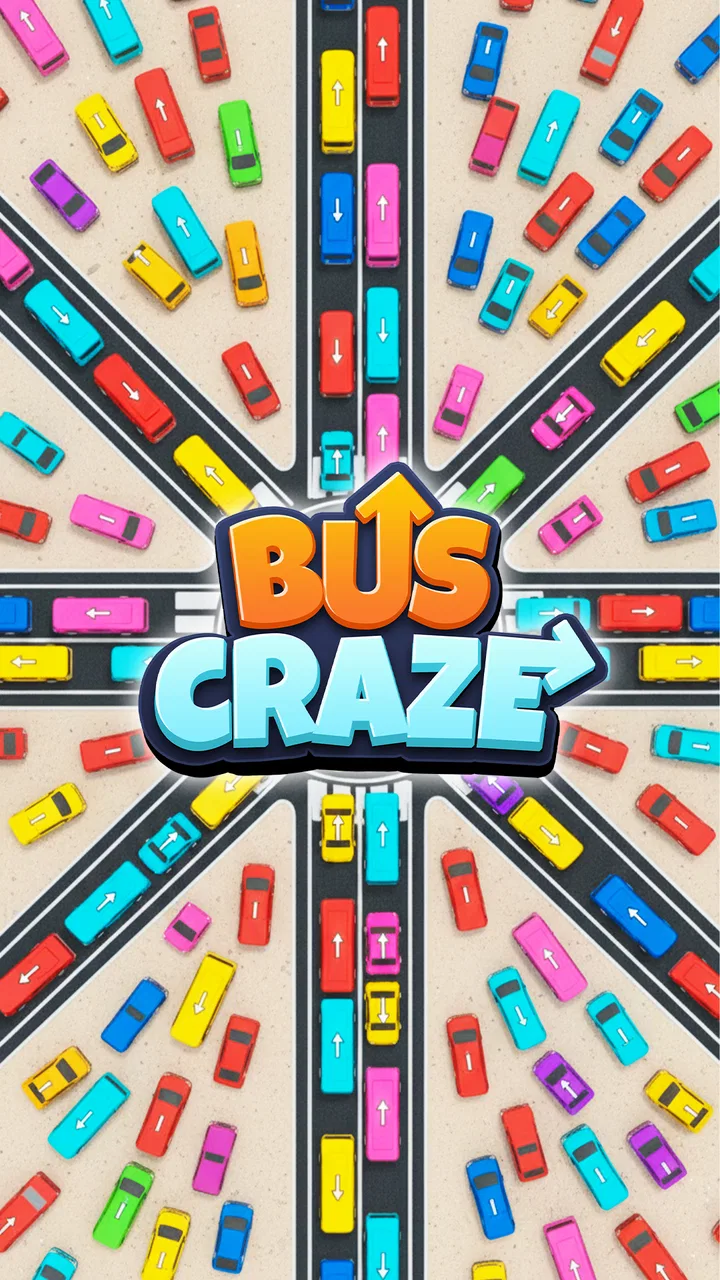
Bus Craze - Traffic Jam Puzzle
- 4.6
- Rating
- 5.00M
- Installs
- Free
- Price

 Analysis by App-foxy
Bus Craze - Traffic Jam Puzzle is the kind of mobile game I can pick up with no preparation, solve a few compact challenges, and put down before it starts demanding my whole evening. Developed by Unico Studio, it sits firmly in the casual puzzle space, using traffic confusion as its central theme and turning a crowded bus situation into a sequence of decisions. The appeal is immediate: look at the jam, work out what should move first, and try to create a clean route for the vehicles and passengers.
That simple premise is also the reason I think its long-term value deserves a closer look. Many puzzle games feel excellent during the first few sessions because the rules are easy to understand and the early stages provide frequent wins. The harder question is whether the game remains satisfying once the novelty of moving buses wears off. After spending time with it, my view is positive but measured: it is a convenient, approachable brain teaser with a strong first-week hook, although players who need constant mechanical variety may eventually notice its limits.
Why the first week feels so inviting
The opening experience is friendly because Bus Craze does not ask me to learn a complicated control system before I can enjoy it. The visual goal is readable, the traffic theme gives each puzzle an immediate context, and the basic pleasure comes from finding order inside a mess. I do not need to memorize a long list of rules. I can study the arrangement, identify the obstruction, and test a solution.
You May Also Like

 Blood Strike: 2.5 Anniversary
Blood Strike’s Loadouts Turn Every Drop Into a Tactical Gamble
A close look at Blood Strike’s custom loadouts: how fast access to signature weapons reshapes its battle royale rhythm, rewards preparation, and narrows the gap between fights.

 Pandora - Music & Podcasts
Pandora’s Music Is Easy to Start, but Harder to Recover
Pandora’s strength is its low-effort path from a seed to a station. Its weak spot is how much confidence it asks you to place in connection, setup, and quiet recovery.

 8 Ball Pool
 Is Built on Rivalries, Rematches, and Routine
A close look at the rivalries, rematches, shared routines, and unanswered safety questions that turn a quick pool match into a persistent mobile community.

 Samsung Music
’s Quiet Strength Is Playing What You Already Own
Its reach comes less from spectacle than from dependable access to a personal library. That simplicity is both the app’s strongest retention engine and its ceiling.

 AccuWeather: Weather Radar
AccuWeather Review: A Quick, Clear Forecast for Everyday Decisions
For everyday plans, the best forecast is the one you can understand quickly. AccuWeather makes rain timing, radar, and local conditions easy to act on, with a few trade-offs.

 Hill Climb Racing
Why Hill Climb Racing Still Turns Crashes Into One More Run
A tiny car, a bumpy hill and one more upgrade: Hill Climb Racing keeps resurfacing because its simple chaos makes every near-miss feel personal.
More From Our News Desk



That makes it especially suitable for short breaks. I can play while waiting for an appointment, during a commute, or between ordinary tasks without feeling that I have started an enormous campaign. A single puzzle can become a small mental reset: instead of scrolling through another stream of content, I spend a few minutes looking for a useful sequence of moves. The game works best when I treat it as a focused pause rather than as a replacement for a large console-style adventure.
The traffic-jam setup also gives the puzzles a more concrete personality than abstract tile matching. When I see buses blocking one another, I naturally begin thinking in terms of access, timing, and consequences. Moving one vehicle may open a path while closing another, so the challenge is not just spotting a matching shape or tapping the brightest object. I am constantly asking which move creates space and which move merely shifts the problem somewhere else.
For a newcomer, the most useful habit is to resist the urge to move the first available bus. I get better results by scanning the entire arrangement first, checking which vehicles are trapped, and identifying any move that could create a chain reaction. This small pause saves failed attempts and makes the game feel more like planning than guessing. It is a simple technique, but it changes the quality of the experience during the early stages.
The game is free to start, which lowers the barrier for anyone curious about this particular style of puzzle. It is rated for Everyone, so its presentation is accessible to a broad audience. That does not mean every stage will feel effortless; the mental challenge can still become demanding even when the theme and controls remain approachable. I would be comfortable suggesting it to a family member who enjoys casual logic games, provided they understand that optional purchases are part of the experience.
Its public response also suggests that the format has reached a substantial audience. Bus Craze has an average rating of 4.6 from around 376 thousand ratings, with more than 5 million installs. Those figures do not prove that every player will enjoy the same pacing, but they do match my impression that the core idea is easy to understand and broadly appealing.
The small decisions that make the puzzles work
The best moments arrive when I stop viewing the board as a pile of separate buses and start treating it as a moving system. A vehicle that appears unimportant may be the key to freeing two others. Conversely, a move that seems productive can create a new blockage if I have not considered the exit route. This is where the game earns its puzzle label: the satisfying solution usually comes from sequence, not speed.
I also found that replaying a stage immediately after a failed attempt can be useful, but only if I can explain what went wrong. Repeating the same moves with a different order rarely helps. Instead, I try to identify the first irreversible mistake, then rebuild the solution from that point. This approach makes the game more mentally rewarding and reduces the feeling that success depends on random experimentation.
Another practical tip is to use the early portion of a level to gather information rather than chase a quick finish. If a move reveals that a route is blocked, that knowledge can be more valuable than making several apparently successful moves. I prefer this deliberate style because it turns difficult boards into small planning exercises. Players who enjoy discovering a solution step by step will likely get more from the game than players who only want rapid tapping.
What remains useful after the novelty fades
The month-to-month question is more complicated. Bus Craze has recurring value when I want a lightweight puzzle that can be opened without a long commitment. Its strongest long-term role is as a dependable filler activity: something I can return to when I have a few spare minutes and want a small problem to solve. That kind of convenience should not be dismissed. A game does not need to become a daily obsession to justify keeping space on a phone.
For me, the habit works best when I set a modest goal, such as clearing a handful of stages or playing until I solve one particularly stubborn arrangement. This prevents the experience from becoming a repetitive endurance session. The game is more enjoyable when I leave after a satisfying solution rather than continuing until every puzzle starts to blur together.
The category matters here. Compared with a traditional match-three game, Bus Craze asks for more forward planning and less reflexive pattern recognition. Compared with a word puzzle, it depends less on vocabulary and more on spatial reasoning. Compared with a large physics-puzzle game, it feels more contained and less theatrical. I would choose it when I want a visual logic problem with a clear objective, not when I am looking for a story, character development, or a broad world to explore.
That distinction helps explain who should keep it installed. It is a good fit for players who like traffic puzzles, orderly layouts, and the satisfaction of untangling a blockage. It is also useful for someone who wants a casual game that can be played in short sessions without needing a complicated setup. On the other hand, players who depend on deep narrative progression, competitive multiplayer, or constantly changing genres of challenge should probably look elsewhere.
The developer’s choice to keep the concept focused is both a strength and a limitation. The focus makes the game easy to return to because I know what kind of mental activity awaits me. I do not have to relearn a different mode each time I open it. But that same consistency can make the experience feel familiar rather quickly if traffic-jam puzzles are not already a favorite.
The current version is 2.8, and the game supports Android 7.0 or later. Those details make it accessible to many existing Android devices, although I would still check the phone’s available storage and performance in everyday use before treating it as a permanent installation. The important point for long-term use is that the game is not aimed only at the newest hardware; its minimum system requirement is relatively broad.
How to build a sustainable play habit
I would not recommend opening Bus Craze automatically every time I feel bored. That turns a focused puzzle into background noise. A better routine is to use it for a defined purpose: a short break after work, a calm activity before bed, or a way to occupy an unavoidable wait. The game benefits from attention, and the puzzles lose some of their charm when I rush through them while doing something else.
It also helps to separate “I am stuck” from “the level is unfair.” When I hit a difficult board, I first review the order of my moves and look for a vehicle that I have treated as an obstacle when it is actually a key to the solution. If I still cannot see the structure, taking a break is preferable to burning through repeated attempts. Returning later often makes the layout easier to read.
One non-obvious advantage is that the game can serve as a gentle transition between activities. Because the objective is concrete and the visual field is limited, I can use one or two puzzles to shift my attention away from a stressful task. It is not a wellness tool, and I would not treat it as one, but the contained problem-solving loop can be more restorative than an endless feed when I use it intentionally.
Where maintenance becomes a burden
The maintenance burden is fairly low in the practical sense: I do not need to learn a complex build system, manage a large collection, or remember an elaborate set of daily responsibilities simply to solve the core puzzles. That is a major reason I can imagine keeping it installed. Its central activity remains understandable even after I have been away for a while.
Still, free-to-play structure can add friction. In-app purchases range from $1.99 to $59.99 per item, so I would approach the game with a clear spending boundary. The free entry point is useful, but the presence of optional purchases means parents should make sure device-level purchase controls are configured appropriately, especially on a shared phone or tablet. I prefer to decide in advance whether I am willing to spend anything rather than make that choice while frustrated by a difficult stage.
This is also where the game may be less suitable for someone seeking a completely uninterrupted puzzle experience. If your ideal app has no purchase prompts, no temptation to accelerate progress, and no commercial friction, a paid puzzle game may be a better fit even if its upfront cost is higher. Bus Craze is more attractive to people who value trying before committing and who can comfortably ignore optional spending.
Another maintenance issue is mental rather than technical. Puzzle games can become repetitive when I play beyond my attention span. The answer is not necessarily to delete the game; it is to keep the sessions short and return only when the format sounds appealing. I would rather preserve the sense of discovery than turn every spare minute into another round of traffic clearing.
For a family, the Everyone rating makes the theme broadly approachable, but age suitability and spending suitability are not exactly the same thing. A child may understand the puzzle while still needing an adult to manage purchase settings. That is a practical distinction worth remembering before installing it on a device used by several people.
Who will get the most value from it
I think Bus Craze is strongest for three kinds of players. The first is the casual solver who likes a clear board and a defined objective. The second is the commuter or busy adult who wants short sessions that do not require a large time investment. The third is the puzzle fan who enjoys planning several moves ahead but does not want a dense interface or a story-heavy presentation.
I would be more cautious recommending it to someone who becomes irritated by repeating a level. The game’s pleasure depends on accepting that a failed sequence is part of the reasoning process. If you want every attempt to feel immediately productive, the traffic-jam format may feel restrictive. Likewise, players who prefer wordplay, trivia, or tactile physics may find that the bus theme does not provide enough variety on its own.
A realistic example is a person with ten minutes before a meeting. They can open the game, inspect a few layouts, and work through a small set of decisions without needing to remember a story or coordinate with other players. If the meeting starts before the puzzle is finished, the interruption is less damaging than it would be in a real-time match. That flexibility is one of the product’s most useful everyday qualities.
What causes fatigue over time
The main risk is repetition of the central mental pattern. Once I become familiar with the way a board wants to be read, some stages can feel less like fresh discoveries and more like variations on a known procedure. The traffic theme remains pleasant, but visual dressing cannot fully replace mechanical variety. This is the point at which players who need novelty may begin alternating it with a different puzzle category.
Difficulty can create a second source of fatigue. A challenging stage is satisfying when I can understand the mistake and improve. It becomes tiring when I feel that I am trying arbitrary orders without gaining useful information. My best defense is to slow down, map the dependencies mentally, and stop after a few unproductive attempts. The game rewards patience, but patience has limits when a session stops teaching me anything.
There is also a trade-off between accessibility and depth. The straightforward presentation is excellent for quick entry, yet it leaves less room for the kind of elaborate strategy found in more complex puzzle games. That is not a flaw for the intended audience, but it does mean that experienced puzzle enthusiasts may eventually want something with more systems, more experimentation, or a stronger sense of progression.
I would not use Bus Craze as my only mobile game for months. I would keep it alongside a word game, a deeper logic title, or a game with a different rhythm. In that role, it avoids becoming stale while still being available whenever I want a focused traffic puzzle. The app earns more lasting value as part of a small rotation than as a single all-purpose entertainment choice.
One useful test is to ask whether I enjoy the process of planning even when I do not solve a stage immediately. If the answer is yes, the game has a good chance of staying interesting. If my enjoyment depends entirely on quick wins, the later experience may feel like work. That difference is personal, but it is more important than the broad rating because it describes the actual relationship a player will have with the puzzles.
My long-term verdict
After the first-week excitement settles, Bus Craze remains worthwhile as a compact, approachable puzzle game rather than as an endlessly expanding hobby. I like its clear traffic-based identity, its suitability for short sessions, and the way it encourages me to think about order and access instead of tapping at random. The game gives me a reason to pause and examine a problem, which is a modest but genuine strength.
Its lasting value comes from convenience and focused problem-solving, not from unlimited variety. That makes it easy to recommend to someone who wants a free puzzle to try on Android and is comfortable managing optional purchases. The broad Everyone rating and support for Android 7.0 or later also make it a practical choice for many users, while the large player response indicates that the basic concept has connected with a wide audience.
I would skip it if I wanted a premium, interruption-free experience, a substantial narrative, multiplayer competition, or a puzzle system that keeps reinventing itself. I would also avoid treating it as a game that must occupy every day. Its best use is more relaxed: install it, learn the rhythm, play a few thoughtful stages when the moment suits you, and switch to something else when the traffic layouts begin to feel too familiar.
For my own phone, that is enough to justify keeping it around. Bus Craze - Traffic Jam Puzzle does not need to become a permanent obsession to succeed. It earns its place as a dependable short-session game with an inviting premise, useful mental friction, and a clear understanding of what it wants to be. If that focused loop matches your taste, I think you will find more value here than the simple theme initially suggests.
FAQs for Bus Craze - Traffic Jam Puzzle
01What is Bus Craze - Traffic Jam Puzzle?
Bus Craze - Traffic Jam Puzzle is a casual puzzle game centered on managing crowded roads and boarding passengers. You must tap, move, or organize buses in the correct order so they can leave without creating additional traffic. As the levels progress, layouts become more complicated, requiring planning, timing, and careful attention rather than fast reflexes alone.
02How do you play Bus Craze - Traffic Jam Puzzle?
The main objective is to clear each traffic-jam scenario by guiding buses and matching them with the appropriate passengers or routes. Before making a move, it is important to check which vehicles are blocking one another and which spaces are available. A careless tap can limit your options, so successful levels usually depend on thinking several moves ahead.
03Is Bus Craze - Traffic Jam Puzzle free to download and play?
Bus Craze - Traffic Jam Puzzle can generally be downloaded for free on supported mobile devices, although the game may include optional in-app purchases. These purchases can provide extra hints, boosters, lives, or other conveniences, depending on the version available in your region. Players should also review the store listing for advertising, payment, and subscription details before installing.
04Does Bus Craze - Traffic Jam Puzzle require an internet connection?
The basic puzzle experience may be playable without a constant internet connection, which makes it suitable for short sessions while traveling or when mobile data is unavailable. However, some features can depend on connectivity, including advertisements, cloud saving, events, rewards, updates, or purchases. Availability may differ between Android and iOS versions, so checking the current store description is recommended.
05Is Bus Craze - Traffic Jam Puzzle suitable for children and casual players?
The game is designed to be easy to understand and generally approachable for casual players, since its controls are simple and the early puzzles introduce the mechanics gradually. Nevertheless, later stages can become challenging and may encourage the use of hints or optional purchases. Parents should check the age rating, advertising content, and device purchase settings before allowing children to play.
Pros
- Simple rules make it easy to start playing immediately.
- Short levels are ideal for quick gaming sessions.
- Colorful visuals and animations make the board easy to follow.
- Increasing traffic challenges provide a satisfying sense of progress.
- Works well for players who enjoy logic and sorting puzzles.
Cons
- Later levels can feel repetitive once the core mechanics are familiar.
- Some stages may depend more on trial and error than planning.
- Mistakes can be frustrating when several moves must be carefully sequenced.
- Frequent advertisements may interrupt the gameplay experience.
- The game may offer limited depth for players seeking a complex strategy title.

Bus Craze - Traffic Jam Puzzle
Gallery